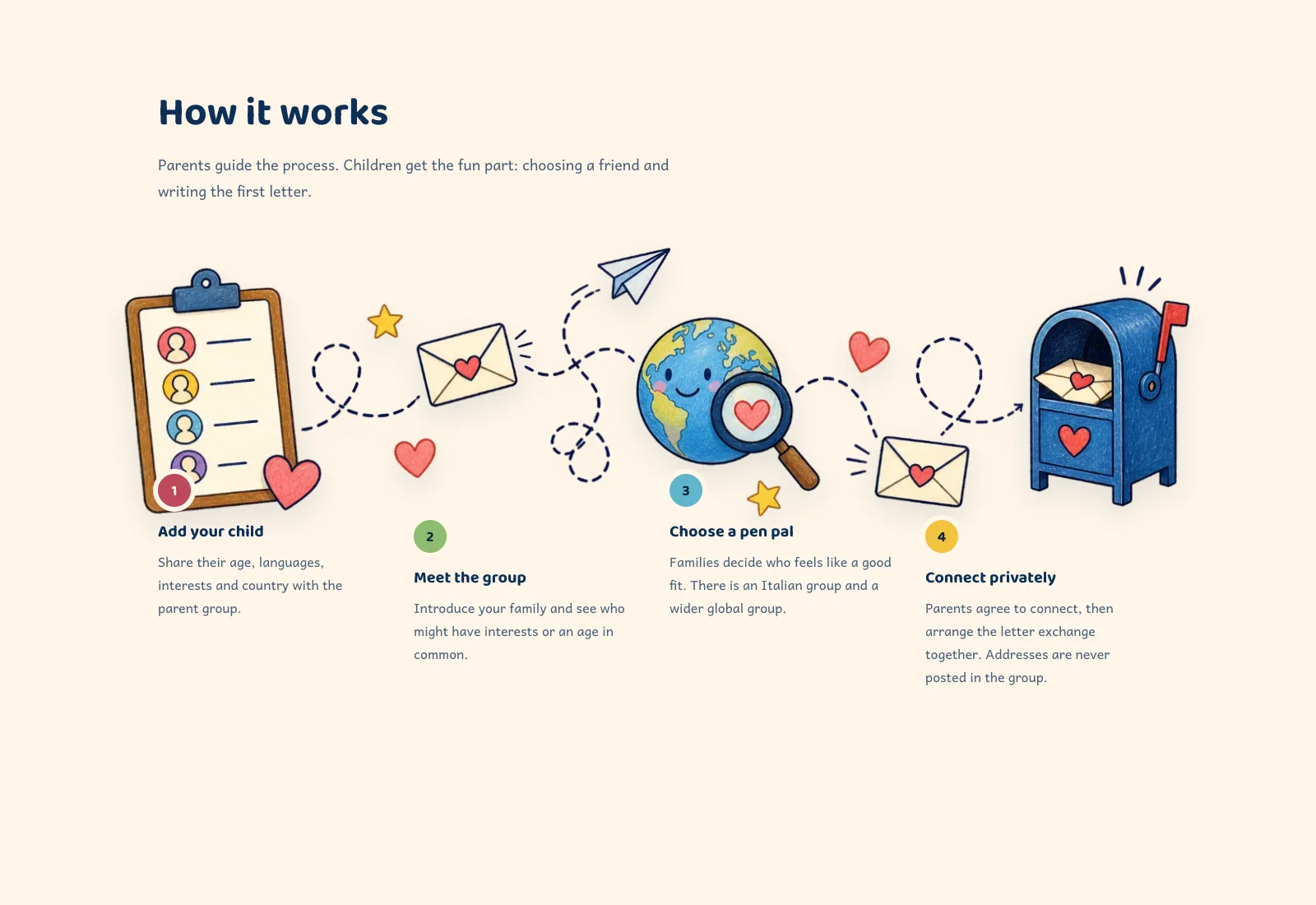
Amici di Penna is a free, not-for-profit pen-pal community for families with children aged 2 to 17. It had outgrown WhatsApp and spreadsheets, so we designed and built the bilingual public site and the private family platform behind it. Parents register, pass manual review, create a child profile, browse short summaries and agree a connection before anyone can send a message. No child's name, contact details or address ever appears in discovery. We hardened the production stack and automated the releases as well.
From WhatsApp and spreadsheets to its own platform
Amici di Penna started as a family-run pen-pal group and grew to more than 160 families around the world. By then the member list, the introductions and the matching were all being carried in group chats and spreadsheets. That works for twenty families. It doesn't work for 160, and it puts a lot of children's details somewhere nobody controls. Parents needed one place to join, find a likely match and manage the exchange, without the group losing what made it feel like a group. We designed the identity and public site around handwritten letters and the link between Italy and Australia, then carried it through into the account area.
Parents lead every step
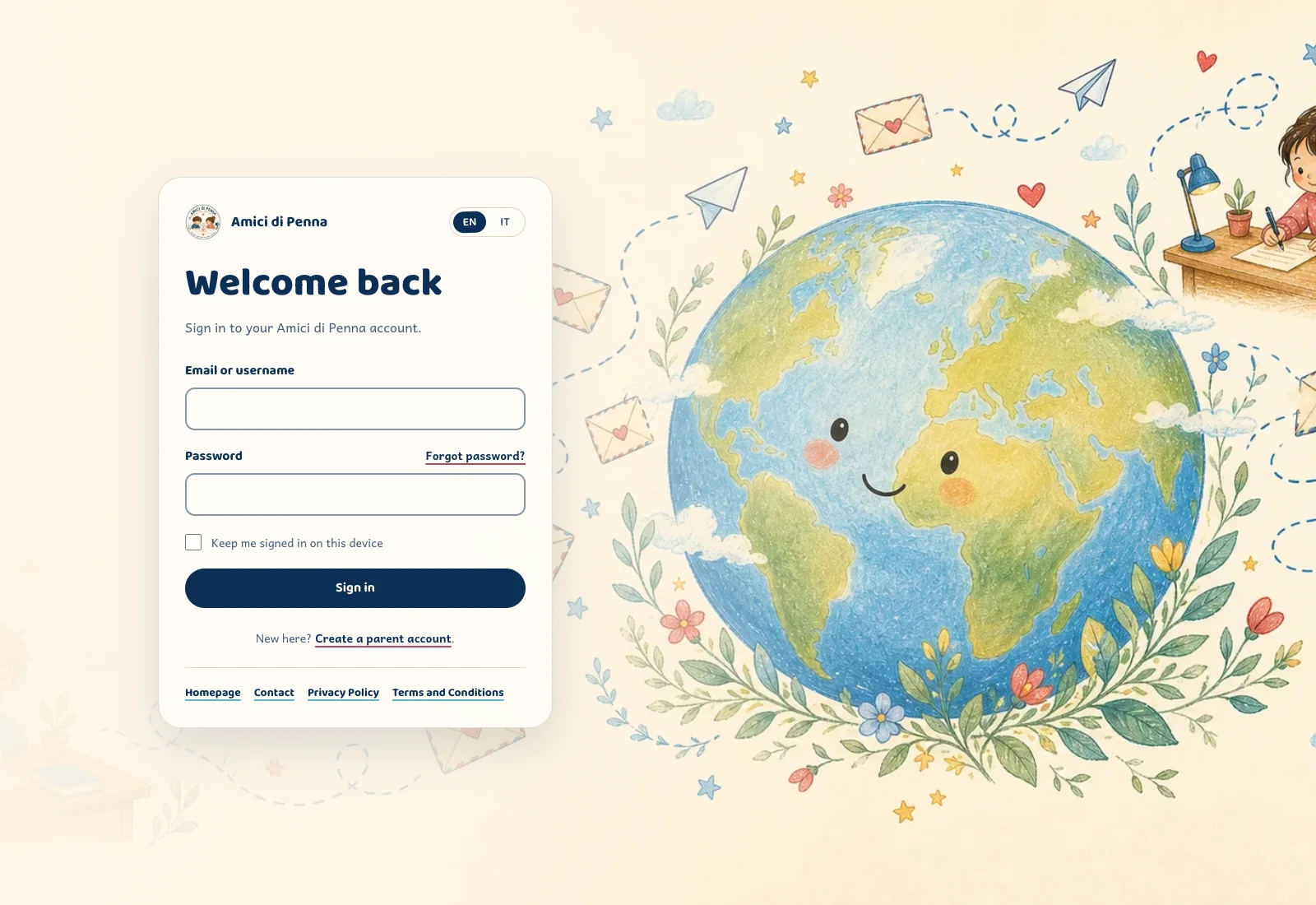
Children write the letters, but adults run the connection. A parent registers, verifies their email, accepts the current policies and waits for manual approval. Once they're in, they can create a child profile, browse summaries from other families, send a connection request, and message the other parent once both sides agree. All of it works in English and Italian, down to the validation messages and the recovery emails, not just the pages a visitor sees first.
Child safety changed the data model
A normal member directory was the wrong shape here. Child profiles are private and owned by the parent account. Discovery shows an age band, country, languages, interests and pen-pal group. It doesn't show a name, date of birth, school, town, phone number or address. Every connection request, message, report, block and deletion runs through an ownership check in the application itself, not just a hidden button in the interface.
Hosting was part of the build
Caddy manages HTTPS in front of Nginx, PHP-FPM and MySQL, with the application services kept on private Docker networks. Firewall rules expose only SSH, HTTP and HTTPS. SSH is key-only and rate-limited, direct root login is off, and Fail2ban and unattended security updates are running. Deployments come from GitHub Actions through a pinned server identity, build a revisioned release and only switch the live path once the new version answers a health check.
Build notes
- A free international community of more than 160 families, split between an Italian group and a wider global group for children aged 2 to 17.
- A custom Bedrock WordPress build using Timber, Twig and ACF, with the family data and application rules kept in a dedicated plugin rather than tied to the public theme.
- Parent-owned child profiles that expose only an age band, country, languages, interests and group during discovery. Names, dates of birth, email addresses, phone numbers and postal addresses stay out of search results.
- Email verification, current policy acceptance and manual account review before a parent can enter the member area, plus private connection requests, reporting, blocking and permanent account deletion.
- English and Italian across the public pages, account journeys, validation messages, metadata and lifecycle emails.
- A hardened production Docker stack with Caddy-managed HTTPS, Nginx, PHP-FPM and MySQL on private service networks, owner-only secrets and security headers at the edge.
- Server rules limited inbound traffic to SSH, HTTP and HTTPS. Password login and direct root access were disabled, with a non-root deploy account, Fail2ban, rate limiting and unattended security updates in place.
- GitHub Actions packages and deploys the current main revision over pinned SSH, activates it only after health checks, and leaves the database, uploads and certificate state persistent between releases.
- Release testing covered 141 isolated browser journeys and 119 PHP tests with 1,184 assertions, backed by static analysis and dependency audits.